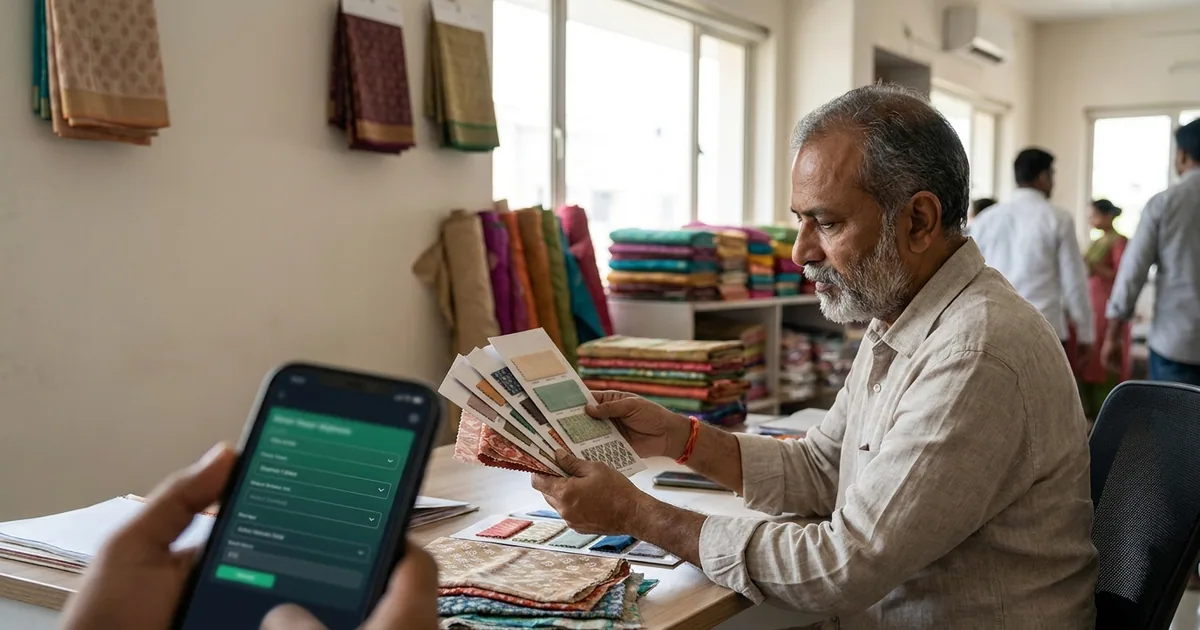
A textile agent in Surat, Ahmedabad, or Bhiwandi processes dozens of fabric bookings every day across dozens of process houses, weaving mills, and garment manufacturers. Rates are discussed over phone calls during market hours, confirmed casually via WhatsApp text or voice note, and logged in a physical diary at the end of the day.
By the time the process house dispatches the grey or finished fabric three weeks later, prices have shifted, yarn rates have fluctuated, or payment terms have been misremembered. When the party receives the invoice at ₹112 per meter instead of the ₹108 they claim was quoted verbally, the dispute lands squarely on the agent.
To protect the deal and preserve the buyer relationship, agents frequently absorb the difference out of their own 1% or 2% brokerage, or spend hours negotiating debit notes between party ledgers and mill accounts. Manual rate confirmations do not just create administrative friction—they directly erode brokerage margins.
The Anatomy of a Rate Dispute in Textile Brokerage
A typical textile brokerage transaction involves three distinct entities: the supplying mill or process house, the commission agent, and the buyer (the party). Because fabric trading operates on thin margins and fast turnaround times, speed often takes precedence over documentation.
[Mill / Process House] <--- Agreed Rate & Specs ---> [Textile Agent] <--- Quoted Terms ---> [Buyer / Party]
                                                          |
                                           Discrepancy at Reconciliation
                                                          |
                                           Margin Loss Absorbed by Agent
A order usually follows this pathway:
- The Verbal Inquiry: The party requests a quote for a specific construction (e.g., 60x60 Cambric or 100D Polyester Printed Satin) for a specific quantity and shade range.
- The Price Negotiation: The agent checks current mill rates, adds or negotiates credit terms (such as 30 days or 60 days credit), and confirms an ex-mill or landed rate with the buyer over the phone.
- The Unstructured Confirmation: The agent sends a brief WhatsApp text: "60x60 Cambric 10,000 mtrs @ 108 fixed." No mention is made of GST, transport charges, folding length, cut size, or payment discount terms (CD).
- The Invoice Discrepancy: The mill bills the order at ₹108 + GST + Freight, or bills at ₹110 because yarn prices rose before grey fabric allocation. The buyer refuses to accept the bill, citing an "all-inclusive" rate of ₹108.
Because there is no signed or structured booking note, the agent cannot prove what was agreed upon. The mill demands full payment based on their dispatch memo, while the buyer deducts the disputed amount from the bill before releasing payment.
How Unwritten Confirmations Bleed Brokerage Margins
Margin loss in a textile agency rarely happens as a single catastrophic event. Instead, it occurs through micro-deductions across hundreds of orders throughout the fiscal year.

1. Ambiguous Price Terms (Ex-Mill vs. Landed)
When an agent books fabric at ₹85 per meter, does that rate include GST? Is freight paid up to the buyer’s godown in Ludhiana, or is it ex-mill dispatch from Jetpur? If the booking confirmation does not explicitly detail freight responsibility and tax terms, the buyer will assume the most favorable interpretation. The agent is forced to cover the freight differential to prevent order cancellation.
2. Unrecorded Payment Discount (CD) Terms
In Indian textile trading, Cash Discount (CD) terms (e.g., 2% CD if paid within 15 days, net 30 days) dictate real transaction margins. When a party pays within 20 days and deducts a 2% CD, but the mill’s policy strictly enforces 15 days, the mill reverses the discount credit in their ledger. The agent’s commission is subsequently put on hold until the ledger balance is cleared.
3. Shade, Quality, and Cut Variations
Fabric parameters require explicit recording:
- Quality construction (warp, weft, reed, pick, GSM)
- Finish type (RFD, Dyed, Softener finish, Digital Print)
- Cut size (e.g., 90 cm fold vs 100 cm full meter fold)
- Delivery timeline and penalty conditions
When a party receives a 90 cm fold invoice but expected a 100 cm full meter cut, they issue a debit note against the bill. If the agent’s booking record does not specify the fold length, the mill denies liability, leaving the agent to handle the balance in the party ledger textile trading statement.
4. Delayed Order Entry and Missing Booking Slips
When orders remain stored in phone call logs or scratchpads for days before being entered into the agency’s central system, dispatch delays occur. If grey fabric rates increase during that delay, the mill charges the higher rate on the dispatch date. The agent cannot pass this rate hike to the party without risking the relationship, converting a profitable deal into a loss.
Moving Beyond WhatsApp: Why Messaging Apps Fail as Order Systems
WhatsApp is an effective communication tool, but it is a poor fabric order booking system.
WHATSAPP CHATS vs. STRUCTURED ORDER MANAGEMENT

WhatsApp Chat Thread:
├── Mixed messages (greetings, rates, payment reminders)
├── Unformatted text ("Send 500 mtrs blue")
├── Screenshots of handwritten slips
└── No searchable structured fields (GSM, Shade, Credit Terms)

Order Form Manager (Structured System):
├── Explicit Party & Mill Profiles linked to GSTIN
├── Standardised Fabric Specification Dropdowns
├── Locked Rate & Payment Terms per Order Item
└── Auto-generated PDF Slips & Automated Commission Ledgers
- Data Fragmentation: Rate confirmations get buried under hundreds of daily chat threads, audio notes, and fabric image attachments. Searching for an agreement made three weeks ago requires scrolling through thousands of messages.
- Lack of Standardization: One chat note might state "5000 mtr PC Cotton @ 62", while another states "5000 mtr PC 62 net including freight". The absence of mandatory fields causes missing terms.
- No Version Control: If a rate is revised mid-order due to quantity changes, older WhatsApp notes remain in the chat history, leading to confusion during final billing.
- No Direct Ledger Integration: WhatsApp conversations do not sync with your accounting software or commission tracking sheets. Staff must manually re-type order details into accounting packages, introducing typing errors in quantities, rates, or party names.
A dedicated textile order management software eliminates these failure points by forcing structure at the exact moment of order capture.
A Digital Fabric Order Booking Workflow
To eliminate rate ambiguity, a textile agency must adopt a digital workflow that captures immutable order parameters before production or dispatch begins.
Watch Full Order Form Manager Video Demo on YouTube
Using purpose-built textile agent software India tools like Innovra’s Order Form Manager, the booking process moves through four structured stages:
Step 1: Party and Mill Identification
The agent opens the mobile application and selects the buyer (Party) and supplier (Mill/Process House) from a pre-configured directory linked with GST numbers, delivery addresses, and default credit terms.
(Mobile interface in dark theme displaying instant lookup for registered buyer parties, mill accounts, GSTIN validation, and established credit parameters.)
Step 2: Inputting Fabric Specifications and Commercial Terms
Instead of typing freeform text, the agent populates standard fields:
- Fabric Quality: Selects or inputs exact construction parameters (e.g., 40s x 40s Cotton Satin, 120 GSM).
- Shade / Design Number: Captures specific shade numbers, print design codes, or colorway lists.
- Quantity & Unit: Defines exact meterage, kilogram weight, or number of rolls/than.
- Rate & Tax Terms: Enters the agreed rate per meter, selecting explicitly whether GST is included or extra, and specifying freight terms (Ex-Factory, FOB, or Door Delivery).
- Payment Terms: Enters payment duration (e.g., 30 Days Net) and applicable Cash Discount percentages.
(Clean mobile UI form showing structured inputs for fabric construction, shade codes, meterage, GST status toggle, freight terms, and CD percentages.)
Step 3: Instant Order Booking Note Generation
Once submitted, the system automatically builds a digital Order Booking Note. This document contains a unique order number, timestamp, full product specifications, commercial terms, and agent details.
The agent shares this generated document directly with both the mill and the buyer via WhatsApp or email with one tap.
Step 4: Automated Commission Ledger Tracking
As the order details are captured digitally, the system logs the booking against the agent’s internal brokerage register. Expected commission amounts (e.g., 1.5% on net fabric value) are automatically calculated and tracked against pending mill payments.
Watch 30s Order Form Manager Overview on YouTube
Comparison: Manual Order Booking vs. Digital Booking System
| Operational Area | Manual Booking (Diaries & WhatsApp) | Digital System (Order Form Manager) |
|---|---|---|
| Rate Confirmation Time | 2–6 hours (back-and-forth phone calls & messages) | Instant (digital booking note generated in 60 seconds) |
| Price Parameter Clarity | High risk of omitting GST, freight, or discount terms | Mandatory fields enforce rate, tax, freight, and CD clarity |
| Dispute Resolution | Relies on memory, diary notes, or lost chat logs | Legally clear digital PDF order note with time stamps |
| Quality Specification | Generic descriptions (e.g., "Cotton Fabric") | Detailed entry (GSM, construction, fold size, shade codes) |
| Ledger Reconciliation | Manual end-of-month tallying from physical bills | Auto-tracked booking register linked to buyer & mill ledgers |
| Order Searchability | Hard to locate historical paper notes or old chats | Searchable by party name, mill, quality, rate, or date range |
Safeguarding the Party Ledger and Mill Reconciliation
Brokerage agencies operate as financial intermediaries. When a buyer delays payment to a mill, the mill turns to the agent to enforce collection. Conversely, when a mill dispatches defective goods or bills at an incorrect rate, the buyer holds back payment from the party ledger.
How Digital Confirmations Simplify Reconciliation
[ Mill Invoice ] <---> [ Digital Booking Note ] <---> [ Buyer Payment Ledger ]
                               |
             Automated Discrepancy Flagging:
             - Rate Mismatch
             - Tax / Freight Term Variance
             - Unauthorized CD Deductions
- Pre-Dispatch Verification: When the mill issues its dispatch memo or invoice, the agent cross-references it with the locked Digital Booking Note before the goods arrive at the buyer's warehouse. If the mill billed ₹110 instead of ₹108, the error is corrected before the buyer receives the invoice.
- Standardized Debit Notes: If a shade defect or shortfall occurs, the buyer issues a claim based on the specified parameters in the original order sheet. This clear record enables the agent to quickly secure credit notes from the mill.
- Brokerage Accrual Accuracy: Brokers calculate their commission on the net invoice value (excluding GST and freight, depending on terms). An explicit digital booking note ensures the mill pays brokerage on the true net order value, preventing underpayment of commissions.
Implementing Digital Booking Sheets in Daily Agency Operations
Adopting dedicated textile agent software India tools like Innovra Order Form Manager does not require changing how you sell fabric—it simply structures how you record and communicate those sales.
Checklist for Agency Managers
- Standardize Quality Descriptions: Maintain a master list of fabric qualities, construction details, and finishes used in your market (Surat, Ahmedabad, Ichalkaranji, Tirupur, etc.).
- Enforce Mandatory Fields: Ensure your sales team cannot save an order without selecting GST status (Included/Extra), Freight terms (Ex-Mill/Landed), and Payment Credit Terms.
- Establish Immediate Sharing Rules: Issue a digital booking slip to both the mill and buyer within 30 minutes of verbal agreement.
- Audit Outstanding Ledgers Weekly: Cross-reference active orders, dispatches, and pending commissions using structured system reports instead of manual diary logs.
Frequently Asked Questions
What happens if a mill or party demands a rate change after the booking slip is issued?
If market conditions require a price adjustment, the agent updates the order in the system to create a revised booking note with a clear revision index and timestamp. This ensures both parties accept the updated rate before dispatch occurs, preventing surprises at billing.
Can old phone contacts and party lists be imported into Order Form Manager?
Yes. Existing buyer lists, supplier directories, and product catalogs can be loaded into the software so agents can select parties, mills, and fabric qualities from dropdowns during fast-paced market hours.
Does using digital booking slips slow down fast trade negotiations?
No. Creating a digital order sheet in Innovra Order Form Manager takes under 60 seconds—faster than writing out a paper booking slip or composing a long WhatsApp text with full specs. Once created, the slip is shared via WhatsApp with a single tap.
How does digital order booking assist in resolving GST discrepancies?
By explicitly selecting whether a quote is "GST Extra" or "GST Inclusive" at the time of booking, the system creates an unambiguous record. If a party attempts to deduct GST value from the invoice payment, the digital order note serves as clear documentation of the agreed terms.
Streamline Your Brokerage Workflow
If ambiguous rate notes and payment disputes are impacting your agency’s bottom line, switching to a structured digital workflow is the simplest operational change you can make. Learn how Innovra's Order Form Manager helps Indian textile agents, traders, and wholesalers digitize fabric order bookings, lock in agreed rates, and protect brokerage commissions.