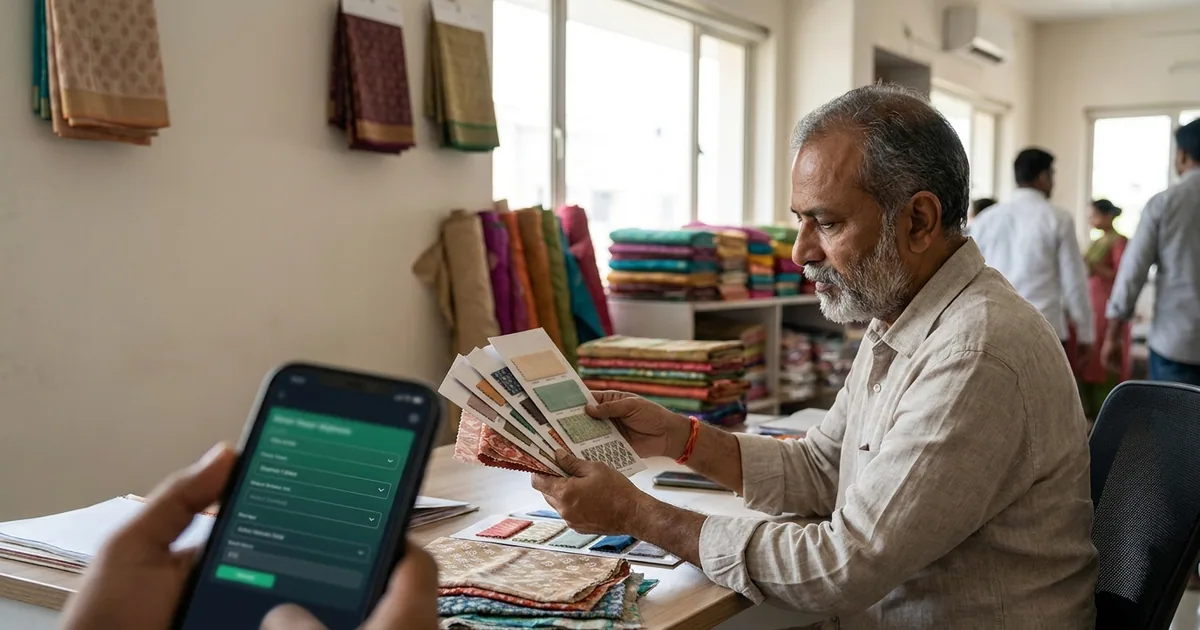
Every evening in markets like Surat’s Ring Road, Ahmedabad’s Kalupur, or Bhiwandi’s powerloom belt, textile agents and traders spend hours sitting with physical registers, WhatsApp chats, and billing software to figure out one basic answer: how much money does each buyer owe, and which mill has actually dispatched what fabric?
In textile trading, a single order rarely moves in a single straight line. A buyer places an order for 10,000 meters of cotton grey or finished rayon fabric across three different shades. The order is split across two weavers or process houses. Dispatches happen in batches of 1,500 meters or 2,000 meters over three weeks. Meanwhile, partial payments arrive via RTGS or cheques, short payments are taken due to quality claims or debit notes, and cash discounts are applied based on whether payment arrived within 30 days or 60 days.
When party ledgers are managed on manual paper registers, excel sheets, or basic accounting tools disconnected from order entries, tracking true outstanding balances becomes an operational nightmare. Pending dispatches get mixed up with delivered bills, credit limits are exceeded without warning, and commission agents lose track of pending brokerage.
Building a clean, automated party ledger textile trading workflow solves this by linking digital order booking, dispatch tracking, and party balances into a single continuous chain.
The Multi-Party Accounting Bottleneck in Textile Trading
Textile agency and trading operations do not fit standard retail or distribution accounting models. Agents and wholesale traders operate in a high-volume, low-margin environment where they act as the operational bridge between mills/weavers and garment manufacturers, wholesalers, or retailers (referred to as "parties").
[Buyer / Party] <---> [Textile Agent / Trader] <---> [Mill / Weaver / Process House]
This triangular model creates three distinct operational balance challenges that generic accounting software fails to handle out of the box:
1. Order Value vs. Dispatched Value Discrepancies
When a buyer books an order (sauda) for ₹5,000,000 worth of suiting fabric, that entire amount cannot immediately be entered as a debt on the party ledger. The debt accumulates incrementally as goods are dispatched from the mill andLR (Lorry Receipt) numbers are generated. A manual register either records the full order upfront—skewing the party's actual financial exposure—or delays updating the ledger until the final invoice arrives, leaving the agent blind to intermediate outstanding exposure.
2. Multi-Part Deliveries Across Multiple Mills
If a wholesale order is split between Mill A (5,000 meters) and Mill B (5,000 meters), dispatches happen at different rates. If Mill A ships 3,000 meters and Mill B ships 1,500 meters, calculating the buyer’s exact outstanding against delivered fabric requires manually cross-referencing dispatch slips from two separate suppliers against a single buyer order sheet.
3. Payment Terms, Discounts, and Debit Notes
Textile trade credit terms often feature tiered payment conditions—for instance, 2% Cash Discount (CD) if paid within 15 days, net payment within 60 days, and 18% interest per annum charged on delays beyond 60 days. When ledger entries are recorded manually at the end of the month, calculating who qualifies for a discount and who owes late payment interest leads to endless payment disputes between buyers and sellers.
How a Digital Ledger Links Orders Directly to Balances
A modern digital workflow eliminates manual ledger entries by turning the order booking form itself into the source data for party ledgers. When an agent or trader books an order on a mobile application or desktop system, every subsequent event—dispatch, partial delivery, payment receipt, and return—automatically updates the party ledger.

Here is how the digital workflow operates step-by-step from order entry to ledger settlement:
Step 1: Booking the Digital Sauda Sheet
When an order is confirmed, the trader or agent inputs the order parameters into specialized textile order management software:
- Party Details: Buyer name, GSTIN, payment terms (e.g., 60 days), assigned credit limit.
- Fabric Specifications: Quality name, count/construction, shade numbers, rate per meter/piece, cut size/fold.
- Supplier Details: Mill or weaver assigned to supply the order.
- Delivery Schedule: Expected dispatch dates and transport details.
The moment the digital sauda sheet is saved, the order enters the system as a Pending Delivery Commitment. It does not debit the financial ledger yet, but it immediately updates the party’s Credit Utilization Status so the agent knows whether to accept further orders from that buyer.
Step 2: Mill Dispatch Tagging and Partial Delivery Updates
As the mill prepares fabric rolls (thaans or bales), dispatch notes and LR details are recorded against the order number.
If Mill A dispatches 2,000 meters out of a 5,000-meter booking:
- The dispatched quantity is deducted from the pending order balance.
- The monetary value of the dispatched 2,000 meters (e.g., 2,000 meters × ₹120/meter = ₹2,40,000 + GST) is automatically posted as a Debit Entry to the party’s financial ledger.
- The LR number, transport name, and dispatch date are attached to the ledger entry for quick verification.
Dedicated UI Workflow Mockup: Dark mode interface (#09090b) showing active party ledgers, current ledger balance, pending order commitment, and credit limit indicators in emerald green (#0d9488).
Step 3: Automated Ledger Posting and Balance Settlement
When payments arrive from the buyer via RTGS, NEFT, or cheque, the transaction is logged against the specific bill numbers or as an advance against open orders.
- Bill-by-Bill Settlement: Payment is allocated directly to the oldest outstanding bill, clearing specified dispatch invoices.
- Automatic Interest / Discount Calculation: If payment is received within the 15-day discount window, the system automatically suggests the cash discount credit note entry. If the payment exceeds 60 days, the overdue days are flagged alongside calculated interest charges.
To see how this end-to-end digital order and ledger flow functions in a real mobile interface, watch the overview below:
Watch Full Order Form Manager Video Demo on YouTube
Structuring Credit Limits, Payment Terms, and Aging Analysis
In wholesale textile markets, extend credit recklessly and you run out of working capital; restrict credit too tightly and buyers will shift their sauda to competing agents. Managing risk requires continuous, real-time visibility into ledger aging.
Real-Time Outstanding Aging Buckets
A digital party ledger textile trading system categorizes all outstanding amounts into clear age-based time buckets:
- Current (0 - 30 Days): Fresh dispatches within standard credit periods.
- Due Soon (31 - 45 Days): Approaching standard payment due dates; automated soft reminders generated.
- Overdue (46 - 60 Days): Standard credit period exhausted; credit warning flagged on new order creation.
- Critical Overdue (60+ Days): Orders blocked automatically; interest accumulation starts.
| Feature / Metric | Manual Paper / Excel Ledger | Generic Accounting Software | Dedicated Textile Ledger Workflow |
|---|---|---|---|
| Order vs. Dispatch Balance | Calculated manually; prone to human error | Requires separate inventory modules | Linked automatically from digital order sheets |
| Partial Delivery Tracking | Tracked on loose slips (sauda slips) | Complex manual invoice splits | Real-time meterage deduction per dispatch |
| Credit Limit Control | Checked manually at end of month | Basic credit limit flag on billing | Real-time exposure check (Outstanding + Pending Orders) |
| Shade / Quality Breakdown | Stored in physical registers | Text-only description fields | Native item tags for shade, fold, cut, quality |
| WhatsApp Outstanding Sharing | Manual typing or photo of register | Manual PDF export and attach | One-click direct WhatsApp statement sharing |
| Brokerage Reconciliation | Manual register entries per mill | Not supported natively | Automatic commission calculation on settled bills |
By comparing these workflows, trading houses can see why generic accounting tools often fail to give an accurate picture of active market exposure.
Handling Multi-Mill Orders and Partial Dispatches Without Discrepancies
Consider a common scenario faced by a commission agent in Surat booking synthetic saree or dress material orders across multiple suppliers:
Scenario: Buyer Rajesh Textiles books 12,000 meters of Printed Rayon (Quality #4040) at ₹85/meter.
- Supplier A (Weaver 1): Assigned 6,000 meters (Shades Red, Blue, Green).
- Supplier B (Weaver 2): Assigned 6,000 meters (Shades Yellow, Pink, Black).
Operational Failure Point Under Manual Tracking
Under manual record-keeping, Supplier A dispatches 3,000 meters on the 5th of the month. Supplier B dispatches 4,500 meters on the 10th. The buyer transfers ₹3,000,000 on the 20th as a round-figure payment without specifying which dispatch it covers.
When the agent attempts to balance the books at month-end:
- They don't know how much money is owed specifically for Supplier A’s fabric versus Supplier B’s fabric.
- They cannot confirm if Supplier A is owed brokerage on 3,000 meters or the full 6,000 meters.
- The buyer disputes the remaining outstanding because 1,500 meters from Supplier A were delayed due to processing defects.
Solution via Digital Wholesale Order Management
Using specialized wholesale order management software like Innovra's Order Form Manager, every dispatch entry requires selecting the mill, LR number, roll/piece quantity, and shade breakdown.
Watch 30s Order Form Manager Overview on YouTube
When Supplier A dispatches 3,000 meters:
- The system updates Buyer Ledger: Debited by ₹2,55,000 (+ GST).
- The system updates Supplier A Account: Marked as dispatched 3,000/6,000 meters. Pending order balance reduced to 3,000 meters.
- The system updates Brokerage Ledger: Agent’s commission account records pending commission for 3,000 meters.
When the ₹300,000 payment arrives, the operator allocates it against the specific LR invoice numbers. Discrepancies are isolated immediately to the specific mill or shade lot without stalling payments across the entire order.
WhatsApp-Based Outstanding Statements and Party Communication
In the Indian textile ecosystem, buyers do not log into complex customer portals to view invoices. They rely on direct communication via WhatsApp.
When payment collections fall behind, agents often hesitate to send formal collection letters because they fear damaging business relationships. A clean, automated WhatsApp ledger summary provides a professional, objective way to communicate balances.
+-------------------------------------------------------------+
| OUTSTANDING LEDGER STATEMENT                                |
| Party: Shree Ramknipa Fabrics, Ahmedabad                    |
| Date: 24-Oct-2024                                           |
+-------------------------------------------------------------+
| Inv #   | Date       | Mill          | Meters | Amount (₹)  |
| LR-402  | 02-Sep-24  | Vimal Process | 2,400  | 2,04,000   |
| LR-489  | 18-Sep-24  | Sumit Shirting| 1,800  | 1,53,000   |
+-------------------------------------------------------------+
| Total Delivered Outstanding:                 ₹ 3,57,000     |
| Pending Undelivered Orders:                  ₹ 1,80,000     |
| Total Exposure:                              ₹ 5,37,000     |
+-------------------------------------------------------------+
| Payment Terms: Net 60 Days                                  |
| Overdue Amount (>60 Days):                   ₹ 2,04,000     |
+-------------------------------------------------------------+
Key Workflow Benefits of Digital Ledger Sharing:
- Instant PDF Generation: Agents can generate a clean party ledger PDF directly from their mobile phone during market visits.
- One-Click WhatsApp Dispatch: Share ledger statements, LR copies, and order confirmation sheets directly to the buyer’s WhatsApp number with one tap.
- Elimination of Rate Disputes: Because order rates, discounts, and terms are locked digitally when the order is booked, buyers cannot claim rate misunderstandings at the time of payment settlement.
Dedicated UI Workflow Mockup: Smartphone view showing automated WhatsApp message preview with attached party ledger PDF, detailed bill breakdown card, and payment link buttons.
Reconciling Brokerage and Commission Across Outstandings
For textile brokers and commission agents (Adhatiyas), managing party ledgers is only half the battle. The other half is tracking and collecting commission from mills and weavers.
Brokers typically earn a percentage commission (ranging between 1% to 3%) on settled sales. However, many mills only pay brokerage after the buyer pays for the goods.
The Double-Ledger Reconciliation Workflow
To ensure commission is never lost or unpaid, a dedicated textile agent software India setup maintains a linked double-ledger system:
[Party Order Booked]
       │
       ▼
[Fabric Dispatched by Mill] ───> [Party Ledger Debited]
       │
       ▼
[Party Pays Invoice] ─────────> [Brokerage Ledger Unlocked]
       │
       ▼
[Commission Claim Issued to Mill]
- Pending Commission Tracking: As dispatches occur, earned brokerage is logged in a "Provisional Commission Ledger."
- Settlement Trigger: Once the party payment is recorded and posted against the dispatch bill, the provisional brokerage automatically converts into an "Active Commission Receivable" due from the mill.
- Mill Commission Statements: At the end of the month, the agent generates a statement showing all fully settled party bills associated with that mill and sends an itemized brokerage bill to the weaver.
Without digital linking between party ledger payments and commission records, brokers lose significant income every year simply because they forget to claim commission on partially settled orders.
Checklist: Transitioning from Paper Registers to Digital Party Ledgers
Upgrading a textile agency or trading business from manual registers to a digital ledger workflow does not require stopping operations. Follow this step-by-step transition plan:
- 1. Audit Active Master Directories: Clean up buyer and mill lists. Ensure each party record includes complete GSTIN, correct legal trading name, market location, primary contact phone number, and standard payment credit days.
- 2. Establish Opening Balances: Transfer existing uncollected outstanding balances from paper registers into the digital party master as opening balances, categorized by age (e.g., under 30 days, 30-60 days, over 60 days).
- 3. Input Active Pending Orders: Enter all unfulfilled or partially fulfilled sauda slips currently open with mills into the digital system.
- 4. Standardize Fabric Quality Masters: Create standard master entries for recurring qualities (e.g., 60x60 Cambric, 40x40 Poplin, Heavy Rayon 14kg) with fixed parameters like fold, cut, and packaging types to avoid manual typing errors during order booking.
- 5. Mandate Mobile Order Entry for Field Sales: Equip sales staff and commission agents with mobile order booking software so orders are recorded digitally on-site at wholesale shops or mill offices instead of on paper slips.
- 6. Enforce Weekly Outstanding Reviews: Schedule a weekly 15-minute review using digital aging reports to flag overdue parties and pause new order bookings for accounts exceeding credit limits.
Frequently Asked Questions
How does digital ledger software handle debit notes for damaged or short fabric deliveries?
When a buyer receives fabric with defects or short meterage, a debit note is entered against the specific LR or dispatch bill number in the system. The digital ledger adjusts the party’s outstanding balance downward for that invoice while simultaneously logging a quality claim tag against the supplying mill for reconciliation.
Can staff access party ledgers on mobile phones while visiting markets?
Yes. Designed specifically as textile order management software, mobile applications like Innovra's Order Form Manager allow sales reps and agents to view real-time party ledgers, pending orders, and credit status directly on their smartphones during market visits in trading hubs like Surat, Ahmedabad, or Jaipur.
What happens if an order is partially cancelled by the mill after booking?
If a mill cannot fulfill the remaining 3,000 meters of a 10,000-meter order, the operator updates the order status to "Short Closed." The system instantly releases the unfulfilled commitment value from the buyer’s credit limit utilization without impacting previously recorded dispatch debits on the party ledger.
How are GST entries calculated when dispatches happen in multiple small batches?
Each partial dispatch recorded in the system calculates the pro-rata taxable value and applicable GST rates (e.g., 5% or 12% depending on fabric type) based on the exact meterage or piece count shipped in that batch. This ensures that party debits match the official GST tax invoice issued by the dispatching mill or trading entity.
Is it possible to migrate existing accounting data from manual registers without losing historical balances?
Yes. Opening balances can be imported or manually entered directly into party profiles as starting debit balances. Outstanding invoices can be entered individually with their original dispatch dates to preserve precise credit aging calculations from day one.
What to Do Next
Managing party ledgers and outstandings does not need to involve midnight calculations over paper registers or endless WhatsApp arguments over unpaid bills.
If you manage a textile agency, wholesale trading office, or commission business, take a close look at your current outstanding tracking process. Identify how many hours your team spends cross-referencing mill dispatches, paper sauda slips, and buyer receipts. Transitioning to a structured digital workflow like Innovra’s Order Form Manager connects your daily order entries directly to live party balances—giving you complete control over credit limits, faster payment recoveries, and accurate commission tracking.